Unlocking Learning Potential
How Metacognition Can Transform Education for Learners on the Autistic Spectrum

What this article is about
This article explores why metacognition—the ability to notice, understand, and guide one’s own thinking—should be treated as a core learning infrastructure for learners on the autistic spectrum, not an optional add-on or a one-size-fits-all strategy. It argues that while accommodations reduce barriers, metacognition builds long-term autonomy, transfer, and self-direction. It also examines how emerging AI tools can support (but never replace) this work when used ethically and deliberately.
Introduction: Beyond Accommodation
When we think about supporting learners on the autistic spectrum, we often focus on accommodations: sensory adjustments, visual supports, modified tasks, or social skills programs. These supports are important and necessary, but they are not sufficient.
What is often missing is explicit support for how learners think, plan, monitor, and adapt their learning. This is where metacognition comes in.
This article argues that metacognition should be treated not as a specialist intervention or enrichment activity, but as a foundational learning capability. When learners are supported to understand and guide their own thinking, they are better equipped to manage cognitive load, advocate for themselves, and make autonomous decisions far beyond the classroom.
What Is Metacognition and Why Does It Matter?
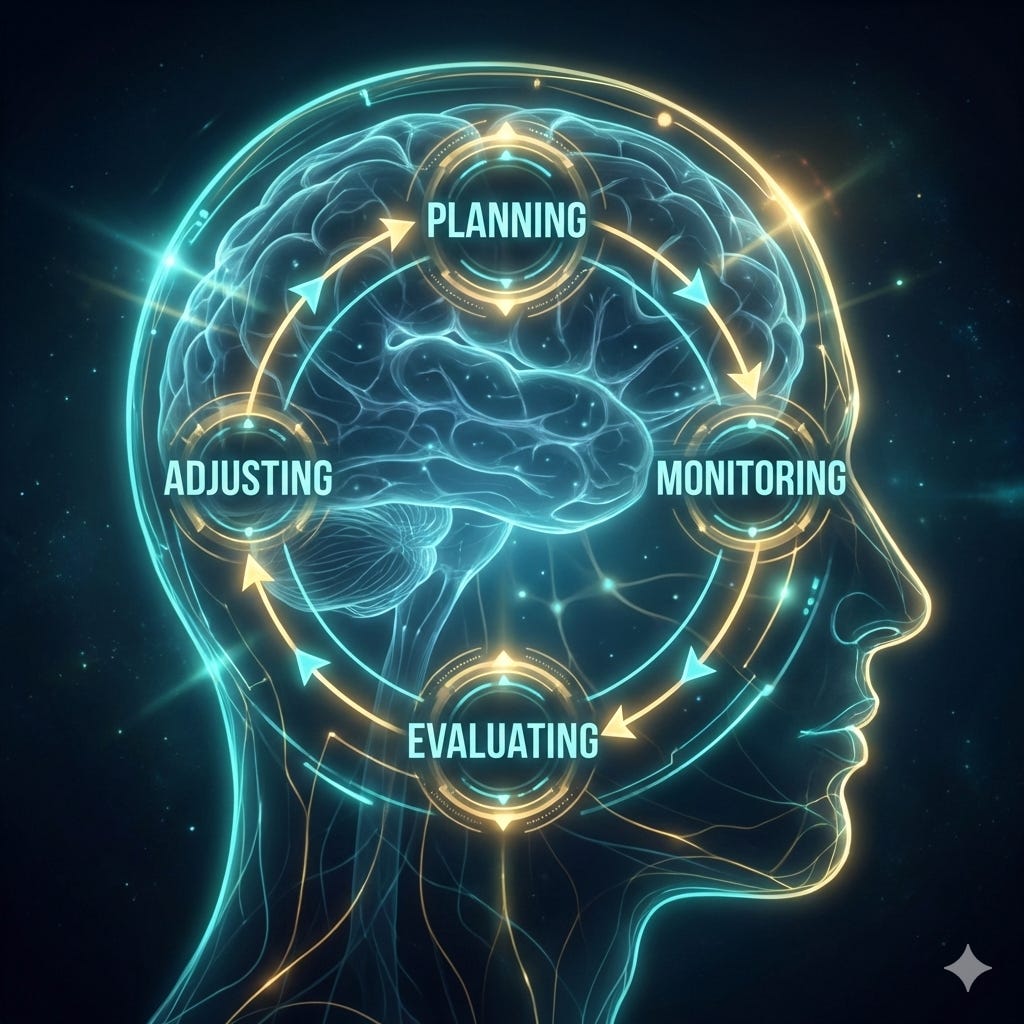
Metacognition refers to our awareness of how we learn and our ability to regulate that learning. It is commonly described through four interrelated processes:
Planning: Deciding how to approach a task.
Monitoring: Noticing what is working and what is not.
Evaluating: Reflecting on outcomes and strategies.
Adjusting: Changing approach based on feedback.
A Spectrum of Thinking Styles
It is vital to recognise that metacognitive ability on the spectrum is often “spiky.” A learner may possess high levels of reflection in areas of intense interest but require significant scaffolding for everyday transitions or social processing. Furthermore, metacognition does not always look like verbal self-reflection. For non-speaking or minimally speaking learners, metacognitive growth is often seen through their use of AAC (Augmentative and Alternative Communication), proactive choice-making, and self-regulation—even if those thoughts aren’t “spoken” in the traditional sense.
The Research Foundation
A growing body of research points to the central role of metacognitive and executive function skills in outcomes for learners on the autistic spectrum. Evidence from tools such as the Behaviour Rating Inventory of Executive Function (BRIEF) shows that skills like working memory, planning, organisation, and self-monitoring are closely linked to independence.
Importantly, contemporary research increasingly frames these differences as processing variations rather than simple impairments. When instruction is designed to align with these diverse processing styles, learners often show significant gains. The goal of teaching strategies should not merely be to compensate for difficulties, but to actively develop a learner’s capacity to understand and steer their own unique brain.
Cognitive Load: Why Metacognition Helps
Cognitive Load Theory explains why learning breaks down when working memory becomes overloaded. For autistic learners, overload may occur more frequently due to sensory input, social interpretation demands, or executive function load.
Metacognition acts as a load-reduction strategy by:
Activating relevant prior knowledge so the brain isn’t starting from zero.
Planning steps to avoid the “blank page” paralysis.
Navigating Monotropism: For those with a monotropic cognitive style (a deep, focused interest), the “Adjusting” phase of learning can feel like a massive derailment. Metacognitive tools act as the “gear shift” that makes these transitions smoother and less distressing.
Practical Metacognitive Strategies
1. Self-Questioning: Building an Internal Guide
Visual cue cards or prompts can help orient attention. These should be offered in multiple formats (text, symbols, or audio):
Before: “What do I already know?” “What is my goal?”
During: “Does this still make sense?” “Do I need a different strategy?”
After: “What helped?” “What would I change next time?”
2. Think-Aloud Modelling: Making Thinking Public
When educators verbalise their own reasoning, including their mistakes, they demystify the learning process. This shows learners that confusion and revision are a normal, healthy part of thinking.
3. Traffic Light Understanding Checks
Non-verbal systems (green/yellow/red) allow learners to signal understanding without the high-stakes demand of verbal explanation. This supports learners who experience strong internal awareness before they have the expressive clarity to describe it.
4. Goal–Plan–Do–Check
This framework externalises metacognition into clear steps:
Goal: What am I trying to do?
Plan: What steps and tools will I use?
Do: Carry out the plan while monitoring.
Check: What worked? What didn’t? Why?
How AI Can Support Metacognitive Development
AI tools can extend metacognitive support when used carefully and transparently.
What AI can do well: Act as a patient thinking partner, ask guiding questions, break tasks into steps, and offer immediate, low-pressure feedback.
What AI cannot do: Replace human relationships, set meaningful personal goals, or understand context without guidance.
Key Applications
AI Chatbots: For guided self-questioning and brainstorming.
Adaptive Platforms: For personalised pacing that respects the user’s need for deep-dive focus or frequent breaks.
Task Management: Digital tools that help visualise the “Plan” and “Do” phases.
Ethical priorities: Data privacy, transparency, and ensuring the learner retains control.
Conclusion
Teaching metacognition is an act of respect. It communicates that learners on the autistic spectrum are capable of understanding and shaping their own thinking. When we move beyond mere accommodation and toward metacognitive empowerment, we give learners a map, but they choose the route.

AI-Generated Image
A Guide for Learners on the Autistic Spectrum
Why this matters. You already think. A lot. Sometimes learning is hard, not because you’re not capable, but because no one has shown you how to notice what your thinking is doing—or how to change it when it stops working. That skill is called metacognition.
You Don’t Need to Think in a Certain Way. There is no “correct” way to think. Some people think in pictures. Some think in words. Some think in deep, intense tunnels. Metacognition is not about changing how your brain works; it’s about understanding your own “spiky profile”—knowing where you are a genius and where you need a tool to help.
Four Questions That Can Help You can use these anytime (think them, write them, draw them, or use a device):
What am I trying to do?
What’s my plan?
How is it going right now?
What could I change if I’m stuck?
Being Stuck Is Information. Being confused doesn’t mean you’re failing. It means your brain is giving you data. Metacognition helps you listen to that data instead of just “pushing harder.”
Using Tools (Including AI). Tools can help you think, but they shouldn’t think for you.
Good tools: Ask you questions and give you time.
Bad tools: Rush you or take control away from you.
You are allowed to learn your own way. Learning isn’t about being fast or loud; it’s about understanding yourself well enough to keep going.
References and Further Reading
Executive Function and Metacognition Research
Andersen, P. N., Skogli, E. W., Hovik, K. T., Egeland, J., & Oie, M. (2015). Associations among symptoms of autism, symptoms of depression and executive functions in children with high-functioning autism: A 2 year follow-up study. Journal of Autism and Developmental Disorders, 45, 2497–2507.
Demetriou, E. A., Lampit, A., Quintana, D. S., Naismith, S. L., Song, Y. J. C., Pye, J. E., ... & Guastella, A. J. (2018). Autism spectrum disorders: A meta-analysis of executive function. Molecular Psychiatry, 23(5), 1198-1204.
Gioia, G. A., Isquith, P. K., Guy, S. C., & Kenworthy, L. (2000). Behavior Rating Inventory of Executive Function (BRIEF). Child Neuropsychology, 6(3), 235-238.
Kenworthy, L., Yerys, B. E., Anthony, L. G., & Wallace, G. L. (2008). Understanding executive control in autism spectrum disorders in the lab and in the real world. Neuropsychology Review, 18(4), 320-338.
Torske, T., Nærland, T., Øie, M. G., Stenberg, N., & Andreassen, O. A. (2017). Metacognitive aspects of executive function are highly associated with social functioning on parent-rated measures in children with autism spectrum disorder. Frontiers in Behavioral Neuroscience, 11, 258.
Wallace, G. L., Kenworthy, L., Pugliese, C. E., Popal, H. S., White, E. I., Brodsky, E., & Martin, A. (2016). Real-world executive functions in adults with autism spectrum disorder: Profiles of impairment and associations with adaptive functioning and co-morbid anxiety and depression. Journal of Autism and Developmental Disorders, 46(3), 1071-1083.
Cognitive Load Theory
Chandler, P., & Sweller, J. (1991). Cognitive load theory and the format of instruction. Cognition and Instruction, 8(4), 293-332.
Paas, F., Renkl, A., & Sweller, J. (2003). Cognitive load theory and instructional design: Recent developments. Educational Psychologist, 38(1), 1-4.
Sweller, J. (1988). Cognitive load during problem solving: Effects on learning. Cognitive Science, 12(2), 257-285.
Sweller, J. (2011). Cognitive load theory. In J. P. Mestre & B. H. Ross (Eds.), Psychology of Learning and Motivation (Vol. 55, pp. 37-76). Academic Press.
Whyte, E. M., Behrmann, M., Molloy, C. A., & Wilson, S. J. (2016). Cognitive theory of autism: The role of impaired metacognition and computational context in explaining autistic symptoms. Research in Autism Spectrum Disorders, 31, 61-71.
AI and Robotics in Autism Education
Alabdulkareem, A., Alhakbani, N., & Al-Nafjan, A. (2022). A systematic review of research on robot-assisted therapy for children with autism. Sensors, 22(3), 944.
Alnafjan, A., Alghamdi, M., Alhakbani, N., & Al-Ohali, Y. (2024). Improving imitation skills in children with autism spectrum disorder using the NAO robot and a human action recognition. Diagnostics, 15(1), 60.
Gómez-Espinosa, A., Moreno, J. C., & Pérez-de la Cruz, S. (2024). Assisted robots in therapies for children with autism in early childhood. Sensors, 24(5), 1503.
Mutawa, A. M., Al-Hamad, N., Alsalman, S., & Hassan, S. (2023). Augmenting mobile app with NAO robot for autism education. Machines, 11(8), 833.
Zhang, M., Ding, H., Naumceska, M., & Zhang, Y. (2022). Virtual reality technology as an educational and intervention tool for children with autism spectrum disorder: Current perspectives and future directions. Behavioral Sciences, 12(5), 138.
AI Applications in Education
Chen, X., Xie, H., Zou, D., & Hwang, G. J. (2020). Application and theory gaps during the rise of artificial intelligence in education. Computers and Education: Artificial Intelligence, 1, 100002.
Hwang, G. J., Xie, H., Wah, B. W., & Gašević, D. (2020). Vision, challenges, roles and research issues of artificial intelligence in education. Computers and Education: Artificial Intelligence, 1, 100001.
Additional Resources
Carretti, B., Caldarola, N., Tencati, C., & Cornoldi, C. (2014). Improving reading comprehension in reading and listening settings: The effect of two training programmes focusing on metacognition and working memory. Learning and Individual Differences, 30, 67-75.
Gilotty, L., Kenworthy, L., Sirian, L., Black, D. O., & Wagner, A. E. (2002). Adaptive skills and executive function in autism spectrum disorders. Child Neuropsychology, 8(4), 241-248.
Tarricone, P. (2011). The taxonomy of metacognition. Psychology Press.
AI was used for research and as a thinking partner.